
Why Marxism fails the human test: Praxeology and the logic of action
By Time Preference

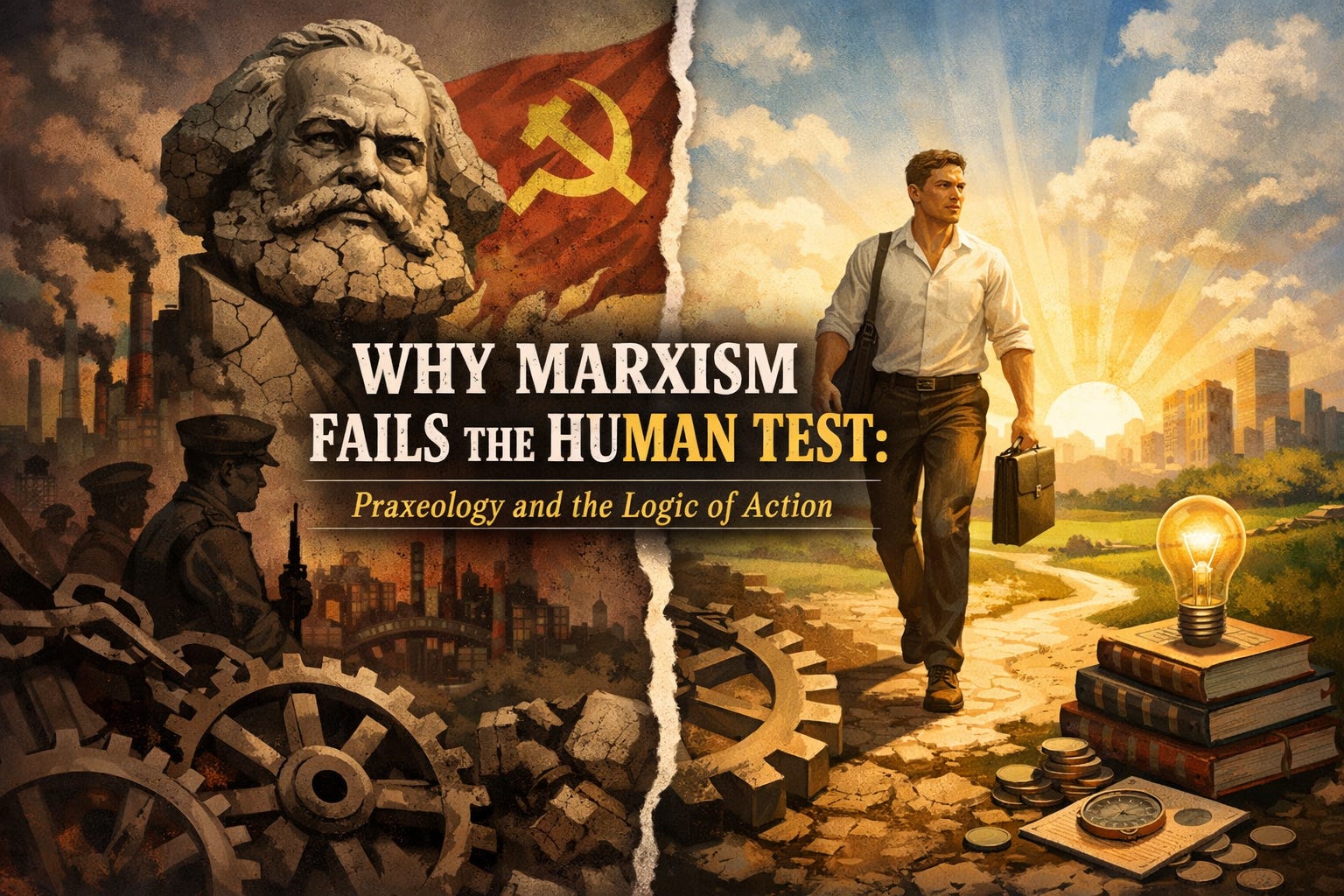
Praxeology is often described as the indicative and distinctive methodology of the Austrian School, coined by Ludvig von Mises, the innovator of this acute method of economic thinking. He was also the economist to successfully apply it extensively to the construction of economic theory. Von Mises begins his work“Human Action”with one simple observation: humans act. This is not an empirical claim; it is a logical truth. To deny that humans act is itself an action. From this axiom flows the entire field of praxeology.
In its purest form, it is the systematic study of purposeful behavior. Economics, in this view, is not a branch of the natural sciences. It does not investigate molecules or magnetic fields, but instead meaning, intention and choice. Since praxeology begins with a true axiom, which one can label A, all the propositions that can be deduced from this axiom must also be true. For if A implies B, and A is true, then B must also be true. Hence, its easy to see why Mises insists on economics being a priori, derived from the logical implications of action, not from statistical aggregates or historical interpretation.
Human action provides us with the understanding that it presupposes scarcity. If the means needed to achieve our goals were unlimited then those goals would already be satisfied meaning there would be no reason to act. Put differently, when a resource becomes superabundant, it stops functioning as a “mean”, because no one must choose or economize it. Air is the classic example. It is essential for life, yet under ordinary conditions it is so abundant that no one treats it as an economic good. It is what Mises called a general condition of human welfare, not an object of action. Only when air becomes insufficient, or when we want it cooler, cleaner or pressurized, does it enter the realm of choice and become a means.
In every generation, Marxism resurfaces with a renewed moral sense of socialist divinity, arguing the same economic carnage, just in softened forms. Nowadays, we see a fresh coat of moral urgency, through notions like “economic justice” and “redistribution for sustainability” or the growing assumption that the state should coordinate prices, rents, wages, and carbon emissions through “rational planning.” At the root of all this lies the same ideological framework Marx espoused over a century ago: that economic life is a mechanism governed by historical forces, and that society advances only when these forces are mastered by a central authority.
At its core, praxeology challenges this conviction. It does not debate Marx’s policy outcomes, but instead rejects Marx’s entire ontology of man and his method of understanding the world. When examined through praxeology, the edifice of Marxism collapses not because of political disagreements but because its core assumptions contradict the nature of human action itself.
Marx did not begin with acting individuals; he began with material conditions and “productive forces” that supposedly determine consciousness. In his framework, human decision-making, is not the starting point of economic explanation but rather its byproduct; a derivative of class position, property relations, and technological development. Marx’s method, therefore, replaces the logic of action with the metaphysics of force.
Praxeology exposes the absurdity: if consciousness is determined by material circumstances, then Marx’s own reasoning is also determined, not freely chosen - and therefore cannot claim truth. A deterministic theory of mind cannot validate itself without self-destructing.
In The German Ideology, Marx and Friedrich Engels write
that life is not determined by consciousness, but consciousness by life. Literally taken, this posits that an individual’s actions, thoughts, and words are determined by their material conditions. The individuality of the person is lost, instead, in its place, there is a notion of ‘class’ acts. This is an ontological perspective that replaces agency with economic geology. Humans, according to a Marxist perspective, are mere sediment shaped by underlying productive strata.
Marx attempted to build an economic theory of value based upon this underlying principle, financed by Engels and other rich financiers to ground value in “socially necessary labor time”; or the average hours required to produce a commodity under typical conditions. In essence, a Marxist perspective towards value involves a belief that value is determined by the labor that goes into the production of a good, an absurd contention according to which things become valuable if work is expended on producing them, regardless of anyone wanting to own them. If you were to spend equal time baking a cake out of mud and a normal cake, Marxists would argue the value to be the same.
Carl Menger resolved this in 1871 with the discovery of marginal utility. A good is valuable not because of the labor invested in it, but because individuals expect it to satisfy a want. The same water that is invaluable when abundant becomes precious in a desert. Labor does not create value; value guides labor. Eugen Böhm-Bawerk later demonstrated that Marx’s labor theory of value contains a circularity Marx never escaped: Marx tries to measure value by labor, but then evaluates labor by the value of its products. It is, unfortunately for Marxists, an unescapable conceptual ouroboros.
The Austrian School completes the critique; value is ordinal, subjective, and personal. And once value becomes subjective, Marx’s theory of exploitation evaporates. Exchange occurs because both parties expect to benefit. A worker sells labor because he prefers the wage to the alternative uses of his time. A firm hires because it expects the product of labor to be worth more than the wage. There is disagreement about the future, not exploitation in the present.
Marx’s theory fails in that he distinctly chooses to ignore the difference in labor formation; two workers with identical hours create goods of radically different value: a software engineer and a potter, for example. The difference lies in subjective demand and preference, not in sweat. As such, the labor theory of value is not wrong because of capitalism, but because of humans.
In modern fiat universities and institutions, Marxists rarely quote Das Kapital, yet they more often than not reproduce its falsified assumptions. Degrowth advocates argue that economic coordination must be centrally managed to prevent environmental catastrophe. Redistribution activists insist that incomes reflect “structural inequality” rather than individual choice. Some even believe algorithmic governance will finally produce the rational planning Marx imagined.
Each ignores the very foundational praxeological truth - treating society as something that can act, choose, and design outcomes from above.
Hayek’s insight in “The Use of Knowledge in Society delivers the corrective: knowledge exists only in dispersed individuals, not in a central brain. Planners cannot know the preferences, trade-offs, or local conditions of millions of people. They cannot integrate tacit knowledge - the unspoken, personal insights that structure daily life - into a spreadsheet.
The praxeological method reinforces this fact. Vvalue is subjective; means-ends reasoning is personal; the future is uncertain. No planner, ministry, or algorithm can replace the spontaneous coordination that emerges when individuals act freely.
Marxism, old or new, therefore fails because it seeks to override the very process through which coordination becomes possible.
Praxeology shows that the foundations of economic life are not material forces but purposeful choices. An economy is the sum of human intentions interacting under uncertainty. Coercion distorts this process; planning overrides it. Marxism remains, at its core, a philosophy that denies agency, misunderstands value, and mislabels deterministic storytelling as science.
Its influence persists only because few confront it on epistemological grounds. Once the logic of human action is understood, Marxism is revealed not as a bold alternative to capitalism, but as a misunderstanding of the human condition.
Praxeology restores what Marxism forgets: only individuals act. Only individuals choose. And only a society that respects these choices can claim to understand economics at all.
Marx turned man into matter. Praxeology returns him to meaning.